
Reflections from the Stakeholder Workshop for Validation of Action Research Findings and Identifying Co-Creation Opportunities
By Mwajuma Salum Basho
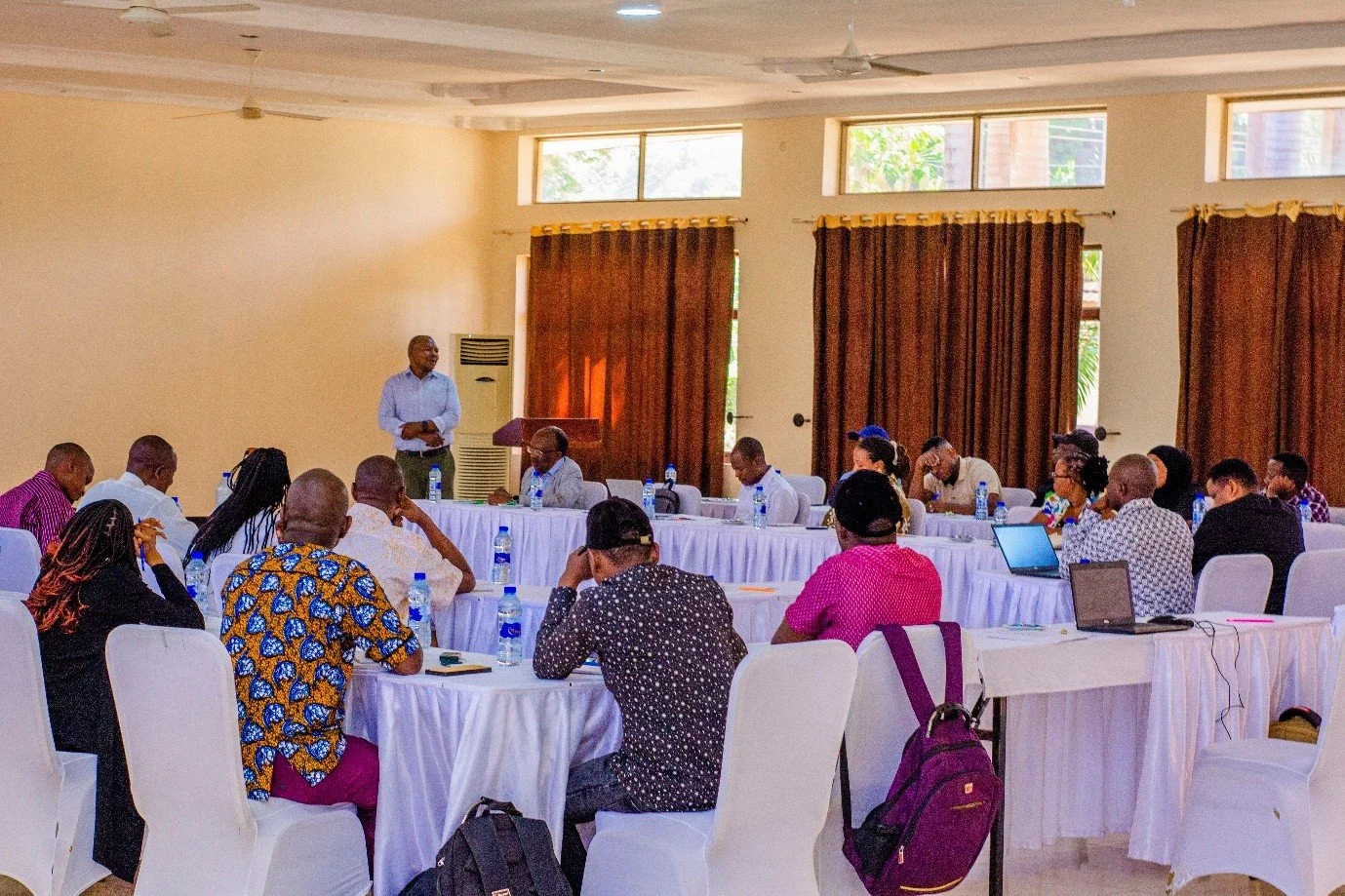
On 5th December 2025, Shahidi wa Maji (SwM) convened a stakeholders’ workshop that gathered 43 representatives from community institutions, government agencies, basin authorities, and national platforms to validate key findings from three action research studies under the Accountability for Water Programme Phase Two (2023–2025). Participants included members from selected Community-Based Water Supply Organisations (CBWSOs), Mitaa Environmental Management Committees (EMCs), Water User Associations (WUAs), RUWASA, Basin Water Boards, municipal councils, and National Advisory Group members, to reflect on evidence, refine recommendations, and co-create actions for strengthening accountability in water resources governance.
Key Findings Highlight Critical Gaps and Opportunities
The validated studies reveal that while community structures, for water governance, such as EMCs, WUAs, and CBWSOs carry essential responsibilities in water resource protection, monitoring, and pollution reporting, they face systemic challenges, including limited financial resources, weak enforcement of penalties, ageing water infrastructure, and inadequate coordination across institutions. CBWSO performance varies widely. CBWSOs located in Kilimanjaro region (Kirua-Kahe and Uchira CBWSOs) demonstrate substantial revenue collection and reliable water supply, while others struggle with non-revenue water and resistance to metering. WUAs also show mixed accountability performance: Weruweru WUA demonstrates strong community-led water allocation systems, while Ngerengere WUA faces barriers such as political interference and insufficient stakeholder collaboration.
Stakeholders’ Voices: Strong Call for Collaboration and Policy Action
Stakeholders emphasised the importance of using evidence to strengthen governance and inform policy: Engineer Herbert Kashililah, who is a member of the Accountability for Water National Advisory Group (NAG), said, “Research is essential to inform policies for water resources management. Research informs where improvement is needed in policy and practice. Government representatives also highlighted collaboration as a core driver of accountability. A Municipal Environmental Officer indicated, “Addressing the problem of water pollution requires collaboration between government institutions and citizens. Community representatives also reinforced the need for institutional support: “We need support from the government to do our responsibilities effectively.”
Stakeholders agreed on immediate collaborative actions for 2026, including: Joint CBWSO–WUA forums on water source protection, Capacity-building workshops for CBWSO boards, and Legal training for EMCs on the Environmental Management Act (2004) and the Water Resources Act (2009), Development of joint pollution response plans for the Msimbazi and Ngerengere Rivers, and Community sensitisation on pollution reporting. These activities—scheduled for January and February 2026—aim to activate citizen-led accountability and strengthen coordination between regulators and local institutions.
A Major Step Toward Stronger Water Governance
The workshop reaffirmed that any single actor cannot achieve accountability for water. It requires collaboration, evidence-based decision-making, and empowered community structures.
SwM will integrate the validated insights into the third year of implementation of Accountability for Water Programme activities, supporting stakeholders to jointly address pollution, improve water service delivery in the case study communities, and strengthen protection of Tanzania’s water sources.